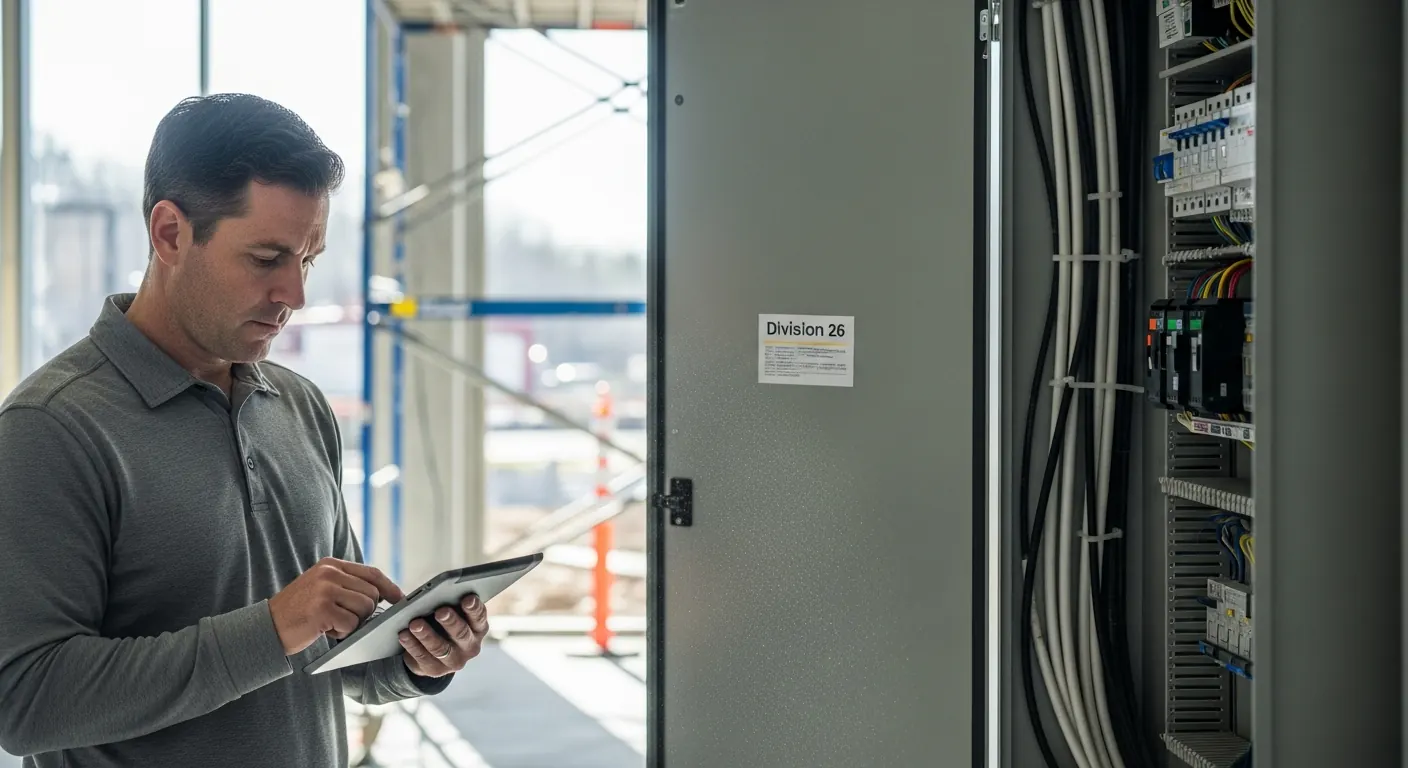


How to Bid Smarter by Letting AI Read the Spec Book First
The best bids don't come from the estimators who work the hardest. They come from the estimators who have the best information at the moment they make pricing decisions.

The best bids don't come from the estimators who work the hardest. They come from the estimators who have the best information at the moment they make pricing decisions.

Estimating has always been a discipline where productivity tools matter. The estimator who can process more information, more accurately, in less time wins more work and protects more margin.

There's no single right way to review a construction spec book. The best approach depends on your role, your scope, your team size, and how much time you have before the bid deadline.

One of the most persistent structural problems in commercial construction is the information asymmetry between general contractors and subcontractors during the bid process.

The product manual has been a fixture of commercial construction for as long as manufacturers have made products complex enough to require documentation.

In competitive construction markets, speed matters. Not the speed of working carelessly, the speed of working with better information earlier in the bid cycle than your competition.

Reading a spec book is one thing. Organizing what you find into something your team can actually use during bid prep and project execution is another.

Every major CSI division has a handful of requirements that matter most for bid prep. Here's a practical cheat sheet covering what each division contains and what to look for first.

Spec review is one of those tasks that every estimator knows is important and almost no one has a formal process for.

The preconstruction phase of commercial construction has always been where projects are won or lost.

Not every estimator has time to read every spec section before pricing, but every estimator needs five specific categories of information. Here's what they are and how to find them fast.

General contractors carry the risk for what their subs miss in the spec. Here's how GCs can use AI to review sub-trade specs before award and catch scope gaps early.

Cutting bid prep time in half sounds like marketing language. It isn't. For most estimating teams, bid prep time is dominated by two activities: takeoff and spec review.

Every estimator has a process for spec review. The problem is that most of those processes developed informally, built from habit, past experience, and the particular way each person was trained.

Bid prep is a process, and like any process, it can be optimized. Most estimating teams have workflows that evolved organically over years of practice rather than being deliberately designed for speed and completeness.

A common question from contractors evaluating AI spec review tools is whether they need a purpose-built tool like SpecSwift or whether they can just use ChatGPT, or another general-purpose AI, to get the same results.

Construction specs have shipped as PDFs for two decades. Here's how PDF spec books compare to AI-powered digital spec tools, and which is actually faster for estimators.

What actually changes when you let AI read the spec instead of doing it yourself? A practical look at the time, accuracy, and coverage differences for estimators evaluating spec review tools.

The market for AI-powered construction technology has expanded significantly over the past few years, and spec review is one of the areas where AI tools are delivering the most immediate and measurable value.

The case for AI-powered spec scanning often gets made in abstract terms. It's faster, it's more complete, it reduces risk.

HVAC subcontractors operate in one of the most technically complex and specification-intensive trades in commercial construction.

Fire protection is a life safety system, which means the spec governing it is written with a level of prescriptiveness that goes beyond most other CSI divisions.

Masonry work looks straightforward from the outside, brick, block, mortar, and some steel. But the Division 04 spec for a commercial masonry scope is anything but simple.

Roofing is one of the highest-stakes scopes in commercial construction. A roofing system failure doesn't just affect the roof. It affects everything below it.

Concrete is one of the most spec-intensive materials on a job. Here's how to pull mix designs, strength requirements, admixtures, and testing protocols fast from a spec book.

Plumbing estimating is detailed work. Pipe sizes, fixture counts, material specifications, pressure requirements, and code compliance all have to come together in a number that's competitive and profitable.

Electrical estimating moves fast. Bid cycles are short, scope is broad, and the margin for error on a competitive electrical bid is thin.

HVAC estimating demands precision across equipment selection, duct sizing, system design, and subcontractor coordination — and the Division 23 spec shapes every one of those decisions. Here's what to extract first and how to do it faster.

The compliance requirements that cause the most damage aren't the obvious ones — they're buried deep in spec sections nobody read carefully. Here's how AI surfaces them before you bid, not after you win.

Product data sheets bury the few lines that decide whether a product meets spec. Here's how AI extracts material standards (ASTM, UL, performance values) from them in seconds.

Submittal management is one of the most process-intensive parts of commercial construction, and it starts with the spec book.

Of all the things an estimator needs to extract from a construction spec book, trade responsibilities are the most consequential and the hardest to find.

If you've never used an AI-powered spec scanning tool before, the process can feel like a black box. Here's exactly what happens from upload to output, so you know what you're getting.

Software can read a construction spec book faster than an experienced estimator. Here's exactly how it works, what it extracts, and why it changes the economics of bid prep.

The product manual review problem in construction is straightforward: the information you need is in the document, but finding it takes longer than it should.

AI-powered spec review isn't a future concept. It's a tool that estimators and preconstruction teams are using right now to reduce bid prep time, catch missed requirements, and process more bids with the same team.

Manual spec extraction is the hidden time drain in preconstruction — the hours spent reading spec books before a single number goes in. Here's why it dominates bid prep and what it costs your team.

Not every change order comes from the owner. Misreading a spec during bid prep creates the kind that quietly eats your margin. Here's how it happens, and how to prevent it.

Skimming a product manual under bid deadline pressure is one of the most consistent sources of costly surprises in commercial construction. Here's what you miss when you skim, and why those missed items have a way of showing up at the worst possible time.

Rework gets blamed on field execution, but a large share of it traces back to errors made during spec review. Here's the connection between spec reading mistakes and jobsite rework, and how to break the cycle.

A missed spec requirement doesn't show up at bid time. It shows up months later, when fixing it is far more expensive. Here's the real financial and operational cost, and how to protect your margin.

Spec review almost always takes longer than contractors budget for it. Here are the structural reasons spec books are hard to read efficiently, and practical strategies to speed it up without sacrificing accuracy.

Scope gaps between trades are one of the most consistent sources of change orders and disputes, and they almost always trace back to trade responsibility language in the spec. Here's how to read it before you bid.

Material standards define the minimum acceptable quality for every product on a job, and they're one of the most commonly misread parts of a spec. Here's what they are, where to find them, and what missing one costs.

Every submittal on a project traces back to a spec requirement. Here's what a submittal log is, how spec sections drive it, and how to build one straight from the spec book.

The CSI MasterFormat division system is the map to any commercial spec book. Here's how specs are organized, the divisions every contractor should know, and how to navigate them fast.

Product manuals decide whether a product meets the spec and passes inspection. Here's what's inside them, what to look for, and how to review them efficiently during bid prep and submittals.

The spec book is the written companion to construction drawings, and one of the biggest time sinks in bid prep. Here's what it is, how it's organized, and how contractors actually use it on the job.

Construction specs define the quality, materials, and workmanship for every part of a project. Here's a plain-English guide to what specs are, how they're structured, and why they matter for bid prep.

Before a single number goes into a takeoff, most estimators spend hours, sometimes days, just reading. Here's why spec review is the hidden time sink in construction bidding, and what that really costs your team.
Found this useful? Share it: