


Share
Ask any construction estimator how their day starts on a new bid, and the answer is almost always the same: they open the spec book. Not the drawings. Not the schedule. The spec book, that dense, tabbed, multi-hundred-page document that tells the story of everything the owner expects on the job.
Before a single unit gets counted or a subcontractor gets called, the estimator has to understand what the project actually requires. And that means reading.
What's Actually in a Spec Book
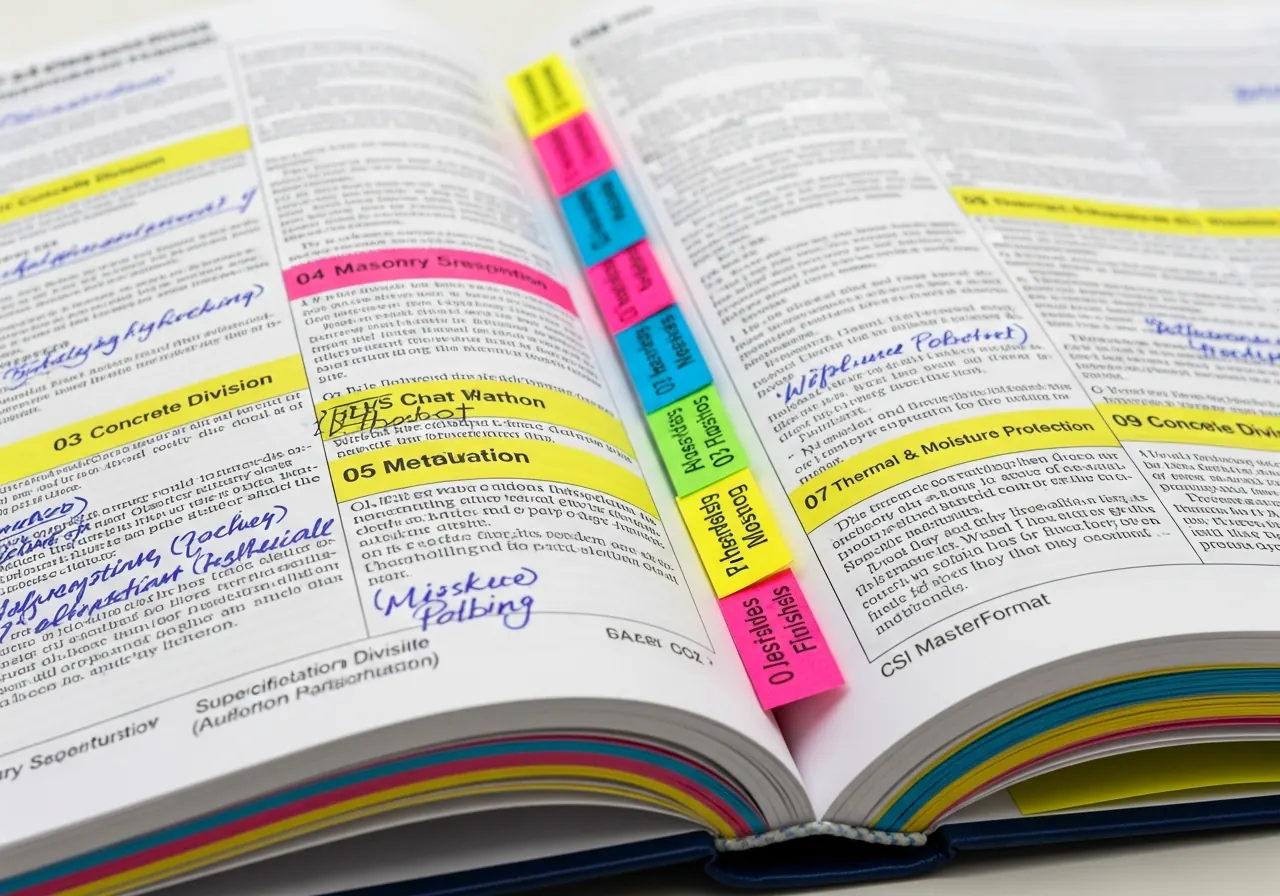
A project specification, or "spec book", is the written legal document that defines the quality, materials, workmanship standards, and contractual requirements for a construction project. It's organized under the CSI (Construction Specifications Institute) MasterFormat system, broken into divisions like:
- Division 03: Concrete
- Division 09: Finishes
- Division 22: Plumbing
- Division 23: HVAC
- Division 26: Electrical
Each division contains sections for specific work scopes. Section 09 90 00 might cover painting and coatings. Section 23 07 00 covers HVAC insulation. Each section runs anywhere from 5 to 30+ pages of requirements, submittals, testing criteria, warranties, and execution standards.
For a moderately complex commercial project, a spec book can easily run 400 to 800 pages. Large institutional or healthcare projects can top 1,200 pages.
Why Estimators Can't Skip the Spec Review
Here's the thing: an estimator who skips the spec, or skims it, is flying blind. The drawings tell you what to build. The spec tells you how.
Miss a requirement in the spec, and you might find out about it after you've been awarded the job. That's when "value engineering" becomes a polite way to say "we underbid." Some common spec-driven surprises that catch estimators off guard:
- Substitution restrictions. The spec lists an approved product manufacturer, no substitutions without architect approval. If you priced a cheaper equal, you may not be able to use it.
- Enhanced performance standards. The spec requires a 20-year warranty on the roofing membrane, not the standard 10-year. That changes what product you can even bid.
- Owner-furnished items. The spec clarifies that the owner will supply certain fixtures, but you're still responsible for installation, a scope you might otherwise exclude.
- Coordination requirements. Division 01 General Requirements can contain pre-bid meeting attendance mandates, BIM coordination obligations, or punch-list procedures that add labor cost.
- Prevailing wage and labor clauses. Buried in the spec is a reference to a local labor agreement or Davis-Bacon requirements that changes your labor rate calculations entirely.
These aren't edge cases. They happen on real bids, routinely, to experienced estimating teams. The spec is where the risk lives.
Industry reality
Construction estimators report spending 2 to 4 hours on spec review before they can confidently begin a takeoff on even a mid-size project. On larger bids, that number climbs to a full day or more, just to understand what the project requires of their trade.
The Hidden Cost of Manual Spec Review
Let's put a number on it. An experienced senior estimator earns $85,000 to $120,000 per year, or roughly $40 to $60 per hour loaded. If they spend 3 hours reviewing the spec before each bid, and your team bids 8 to 10 projects per month:
- 3 hours × 10 bids × $50/hour = $1,500/month per estimator just on spec review
- That's $18,000 per year, before accounting for the bids they couldn't take because the team's capacity was tapped out
And that's the direct cost. The indirect cost is harder to measure: the bids your team couldn't pursue because the estimators were buried. The jobs you walked away from because they didn't have time to do a proper review. The tight margin you submitted because spec review ate into the time you had to sharpen your numbers.
Why the Problem Is Structural, Not Personal
This isn't a skills problem. The most experienced estimators in the industry face the same constraint: spec books are long, dense, and not designed for fast reading. They're written by attorneys and specification writers for legal precision, not for the person who needs to price the work in 48 hours.
The format hasn't changed meaningfully in decades. CSI MasterFormat was first published in 1963. The underlying workflow (read, highlight, tab, take notes) is largely the same. The documents have gotten longer as projects have gotten more complex, but the tools estimators use to process them haven't kept pace.
Spec writers and owners also don't think about the estimator's workflow when they write. Requirements are scattered across multiple sections. A submittal requirement for a window assembly might appear in Division 08 (Openings), Division 01 (General Requirements), and a project-specific supplementary conditions document. An estimator has to triangulate across all three.
What Good Spec Review Actually Looks Like
When experienced estimators review a spec, they're not reading every word. They're doing a fast, targeted extraction:
- Scope confirmation. What divisions are relevant to my trade? Are there any unusual scope inclusions or exclusions?
- Product and material requirements. Is the spec open, or does it name specific manufacturers? Are there performance thresholds that require premium materials?
- Submittal and testing requirements. What does the owner require us to submit, and when? Are there mandatory mock-ups, inspections, or commissioning requirements?
- Warranty obligations. Standard or extended? Who holds the warranty: the GC, the sub, or the manufacturer?
- Division 01 flags. Liquidated damages, project schedule constraints, site access restrictions, union labor requirements.
A skilled estimator can do this in 2 to 3 hours on a familiar project type. A junior estimator on an unfamiliar spec might take twice as long, and still miss things.
The Opportunity: What Changes When Spec Review Gets Faster
When estimating teams can cut spec review time, even by half, the compounding effects are significant:
- More bids pursued. Teams can evaluate more opportunities because the initial go/no-go spec review is fast enough to do on every incoming job, not just the obvious ones.
- Better numbers. When less time is consumed on reading, more time can go into sharpening quantities, calling subs, and working the margin.
- Lower risk of missed requirements. A structured spec extraction catches things that manual reading misses, especially under time pressure.
- Junior estimators can move faster. When the spec review is augmented, less experienced team members can handle bids that previously needed a senior estimator.
This is exactly the problem SpecSwift was built to solve. Upload your project spec, select your CSI trade divisions, and get a structured extraction of every requirement relevant to your bid, in seconds, not hours. The AI reads the full spec so your estimators don't have to.
Further reading: What Are Construction Specifications and The Real Cost of Missing a Spec Requirement.