


Share
If you've spent any time in commercial construction, you've heard the word "specs" thrown around on every job. But what exactly are construction specifications, and why do they matter so much during bid prep and project execution? This guide breaks it down in plain English, no architecture degree required.
The Basic Definition: What Construction Specs Actually Are
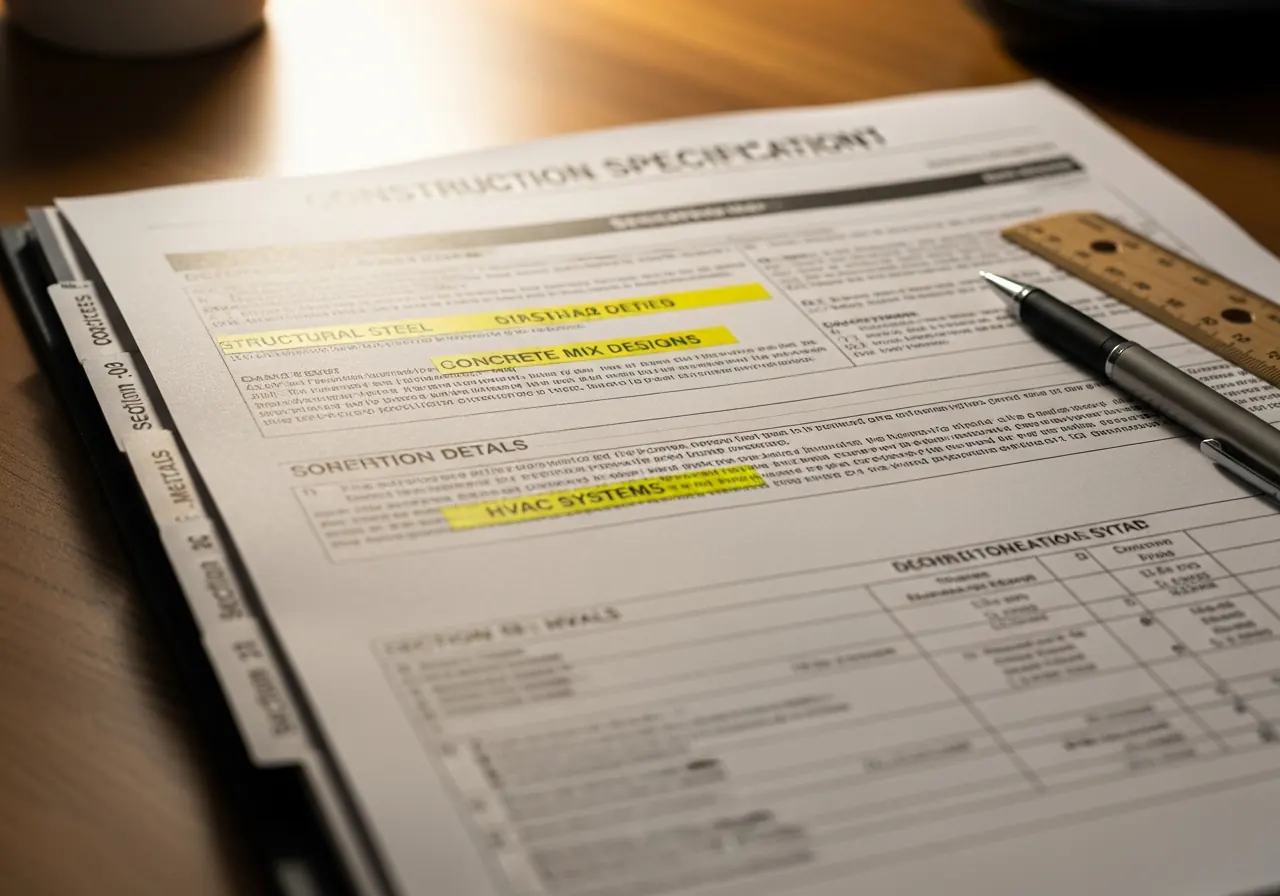
Construction specifications are written documents that describe the quality, materials, workmanship, and performance requirements for every element of a building project. They work alongside the drawings, while drawings show where and how big, specs define what and how good.
On a commercial project, specs are typically compiled into a spec book, a single document (often a PDF) that covers every trade scope on the job. A large hospital or office building might have a spec book that runs 600, 800, even 1,000 pages across dozens of sections.
Specifications are organized using MasterFormat, a standardized numbering system developed by the Construction Specifications Institute (CSI). That system breaks construction work into divisions, Division 03 for Concrete, Division 09 for Finishes, Division 26 for Electrical, and so on. Each division contains individual spec sections that address specific products, systems, or scopes of work.
Understanding this structure is the first step to reading specs efficiently. Once you know where to look, you stop wasting time hunting through irrelevant sections.
The Three Parts of Every Spec Section
Almost every spec section in a modern construction project follows the same three-part format:
Part 1, General: Administrative requirements. This is where you'll find submittal requirements, quality assurance standards, delivery and storage requirements, warranty language, and project closeout obligations. Estimators often skim Part 1, which is a mistake. It contains real cost items.
Part 2, Products: Material standards, approved manufacturers, product specifications, mix designs, finishes, and performance criteria. This is where ASTM standards, UL listings, and approved product lists live.
Part 3, Execution: Installation requirements, workmanship standards, field testing, inspection requirements, and coordination responsibilities. This part defines how the work gets done and who's responsible for what.
When you understand this structure, you can move through a spec book faster, because you know which part to go to for the information you need.
Why Construction Specs Matter for Estimators and Contractors
Specs aren't just a legal formality. They directly affect your bid, your scope, and your margin. Here's why:
- Specs define scope boundaries. If you're a mechanical sub, the spec tells you whether you furnish and install a piece of equipment or just install it. Miss that distinction and you've either over-bid or under-bid the job.
- Specs set material standards. An approved manufacturer list in Division 08 might allow three door hardware suppliers, or it might specify one and prohibit substitutions. If you price a product that isn't on the approved list, you'll either eat the upcharge or fight for an approved substitution during submittal review.
- Specs create submittal obligations. Shop drawings, product data sheets, samples, and O&M manuals are all spec-driven requirements. Each one takes time to prepare and has a review cycle. If they're not accounted for in your bid, they become overhead you didn't price.
- Specs trigger testing and inspection. Some spec sections require third-party special inspection, mockups, or performance testing. These have direct costs and scheduling implications that need to be in the bid.
Missing any of these items during bid prep doesn't make them go away. It just means you find out about them later, when fixing the problem costs more.
How AI Is Making Spec Review Faster
Traditionally, reading and extracting information from a construction spec book is a manual, time-consuming process. An estimator on a mid-size commercial job might spend 6 to 10 hours just on spec review before a single quantity gets counted.
AI spec review tools are changing that. By uploading a spec book PDF, estimators can now extract material standards, submittal requirements, trade responsibilities, and compliance language automatically, organized by CSI division and ready to act on.
This doesn't eliminate the need for an experienced estimator. It eliminates the hours of manual reading that happen before that estimator's judgment gets applied. The result is faster bid prep, fewer missed requirements, and more bids pursued with the same team.
Further reading: What Is a Spec Book and Why Estimators Spend Hours on Spec Books Before They Even Start a Bid and Free CSI Division Cheat Sheet: What to Look For in Each Section.