

Share
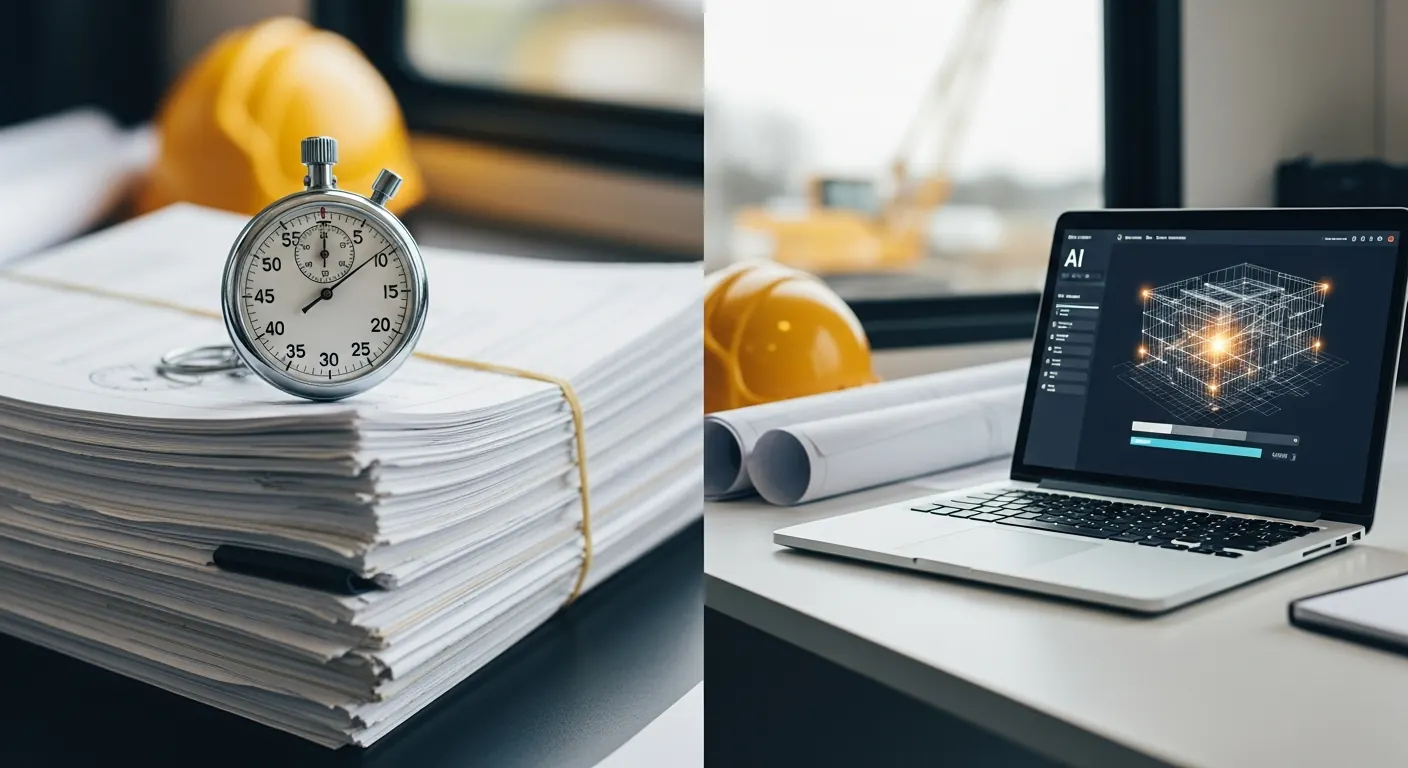
The case for AI-powered spec scanning often gets made in abstract terms (it's faster, it's more complete, it reduces risk. But abstract comparisons don't mean much when you're trying to decide whether to change a workflow that's been working for years. This post makes the comparison concrete. Same project, same spec book, same categories of information to extract) manual process vs. AI process, with realistic time estimates for each step.
The Scenario
Mid-size commercial office building. 180,000 square feet, four stories, steel structure with composite deck, curtain wall exterior, full MEP scope. Spec book is 420 pages across 58 CSI sections. The estimating task is a mechanical subcontractor bid covering Division 22 (Plumbing) and Division 23 (HVAC), 22 relevant spec sections totaling approximately 140 pages.

The estimator needs to extract: pipe material requirements by service, equipment specifications and approved manufacturers, insulation requirements, submittal requirements, testing and balancing scope, commissioning requirements, controls interface requirements, and trade responsibility language from adjacent divisions.
Manual Spec Review: Step-by-Step Time Breakdown
Reading Division 01 for project-wide requirements: 45 minutes. Division 01 on a 420-page spec book runs 35 to 50 pages. The mechanical estimator reads it to identify submittal procedures, quality control requirements, testing and inspection program requirements, and any project-specific requirements that affect mechanical scope.
Reading Section 22 05 00, Common Work Results for Plumbing: 30 minutes. This baseline section establishes pipe material requirements, joining methods, hangers and supports, and testing requirements for all plumbing work. It's dense and needs to be read completely.
Reading through Division 22 equipment and system sections: 60 minutes. Seven to ten spec sections covering domestic water, sanitary drainage, plumbing equipment, and plumbing fixtures. Extracting pipe specifications, approved manufacturers, fixture specifications, and submittal requirements while taking notes.
Reading Section 23 05 00, Common Work Results for HVAC: 30 minutes. Baseline HVAC requirements, same level of detail and importance as the plumbing baseline section.
Reading through Division 23 equipment and system sections: 120 minutes. Twelve to fifteen spec sections covering HVAC equipment, ductwork, piping, insulation, controls, testing and balancing, and commissioning. This is the most time-intensive part of mechanical spec review.
Reviewing adjacent divisions for trade responsibility language: 45 minutes. Scanning Division 26 electrical sections for HVAC power connection responsibilities, Division 28 for duct smoke detector interfaces, and Division 25 if a separate controls spec exists.
Organizing notes into usable bid prep information: 45 minutes. Converting handwritten notes, PDF highlights, and mental notes into a structured list of requirements, approved manufacturers, submittal obligations, and cost items.
Total manual spec review time: approximately 6 hours.
And this is an efficient manual review by an experienced estimator who knows exactly what they're looking for and has a systematic process. A less experienced estimator, or one working with more interruptions, might spend 8 to 10 hours on the same document set.
AI Spec Scanning: Step-by-Step Time Breakdown
Uploading the spec book PDF: 2 minutes. The full 420-page spec book uploads in under two minutes on a standard internet connection.
Specifying extraction scope: 3 minutes. The estimator selects the relevant CSI divisions (01, 22, 23, and adjacent sections for trade responsibility review) and specifies the extraction categories, pipe materials, equipment specs, approved manufacturers, submittal requirements, testing scope, commissioning requirements, controls interface language.
AI processing time: 3 to 5 minutes. The AI scans all 420 pages, identifies relevant sections, extracts the specified categories, and organizes the output by division and section number.
Reviewing AI output: 20 to 30 minutes. The estimator reviews the organized extraction results, verifies key items against the original spec for accuracy, flags items that need follow-up, and identifies any gaps in the AI output that require manual review.
Total AI spec review time: approximately 30 to 40 minutes.
What the Time Comparison Actually Means
The time difference, 6 hours vs. 35 minutes, is significant on its own. But the compounding effect is where it really matters.
A mechanical subcontractor bidding 10 jobs per month spends approximately 60 hours per month on spec review using a manual process. With AI extraction, that drops to roughly 6 hours per month, a recovery of 54 hours of estimating capacity every month.
That recovered capacity can go toward:
Pursuing more bids. With 54 hours recovered per month, the same estimating team can evaluate and bid significantly more work without adding headcount. At a 25 percent hit rate, more bids mean more revenue.
Better analysis on existing bids. Time that was previously consumed by document reading can go toward scope analysis, subcontractor outreach, value engineering, and risk assessment, the estimating work that actually requires judgment and expertise.
More complete bids. AI extraction is more consistent than manual review under deadline pressure. Requirements that get missed on the seventh bid of a busy month get caught by AI every time. More complete bids mean fewer surprises during construction and better margin protection.
What the Comparison Doesn't Show
Time is the most quantifiable difference between manual and AI spec review. But there are qualitative differences that don't show up in a time comparison:
Consistency. AI extraction quality doesn't vary with fatigue, deadline pressure, or the complexity of the previous bid. Manual review quality does.
Completeness. AI processes every word of every section. Manual review under time pressure involves judgment calls about which sections to read carefully. Those judgment calls sometimes go wrong.
Traceability. AI output is organized by spec section and traceable back to the source document. Notes from manual review are only as organized as the estimator's note-taking process.
None of these qualitative differences show up in a side-by-side time comparison. But they're real, and they affect the quality of every bid that goes out.
Further reading: How to Use AI to Extract Requirements from a Construction Spec Book and How to Cut Bid Prep Time in Half Using AI on Your Spec Documents and Best AI Tools for Construction Spec Review in 2026.
That's posts 26 to 30. Ready for 31 to 35 whenever you say go.