

Share
If you've ever opened a commercial construction spec book and felt immediately lost, the CSI division system is the map you need. Once you understand how specs are organized, and why, navigating a 600-page spec book becomes a lot less overwhelming. This post explains the CSI MasterFormat system, how it structures construction specifications, and what estimators need to know to use it efficiently.
What Is CSI and What Is MasterFormat?
CSI stands for the Construction Specifications Institute, a professional organization that develops standards for construction documentation in the United States. Their most widely used standard is MasterFormat, a numbering and organizational system for construction specifications that's used on virtually every commercial project in the US.
MasterFormat organizes all construction work into numbered divisions. Each division covers a broad category of construction scope, and within each division are individual spec sections that address specific products, systems, or types of work.
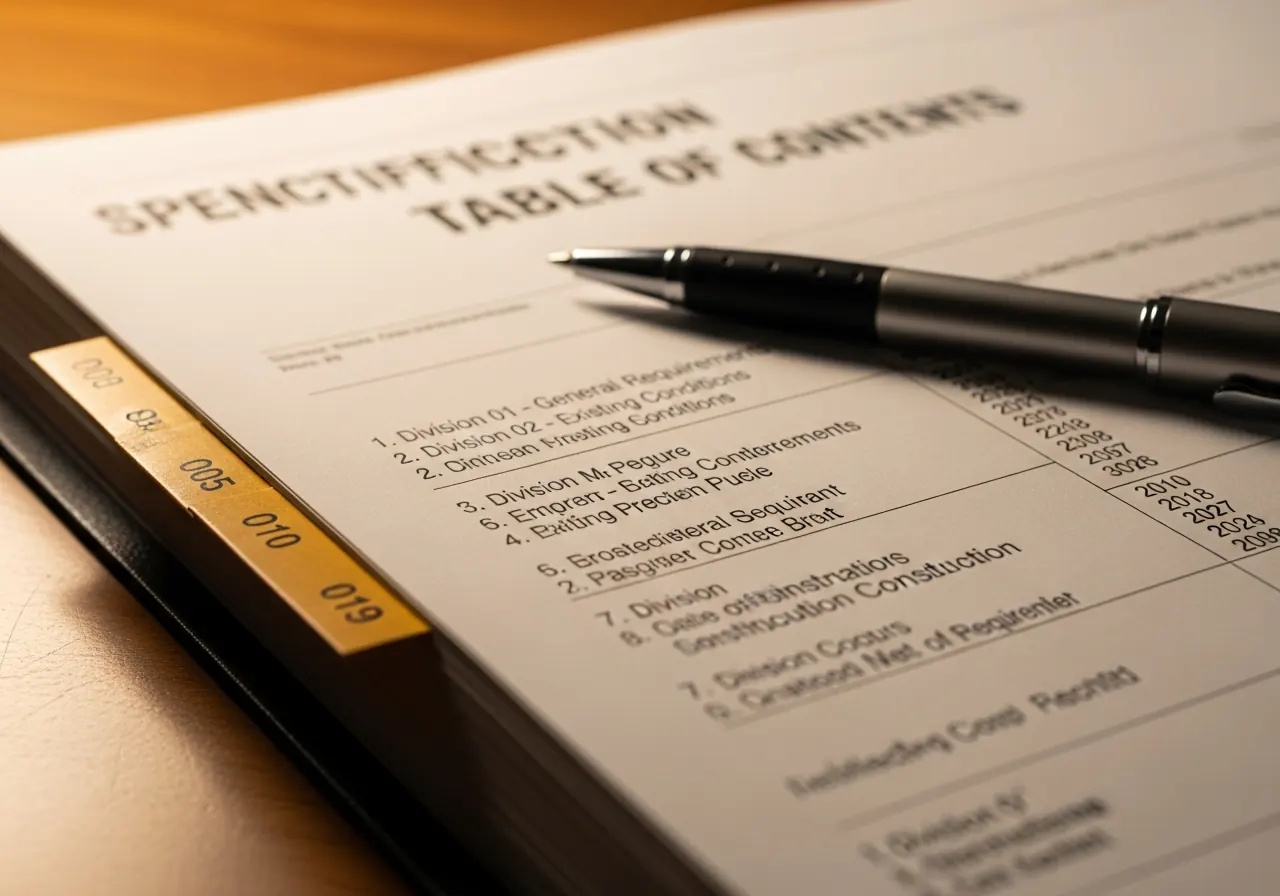
The current MasterFormat system uses a six-digit numbering format. A spec section number like 03 30 00 breaks down as:
- 03: Division (Concrete)
- 30: Section group (Cast-in-Place Concrete)
- 00: Section subgroup
This numbering system is consistent across projects, which means once you know that roofing is Division 07 and electrical is Division 26, you can find those sections in any spec book from any architect on any project.
The Major CSI Divisions Every Contractor Should Know
MasterFormat includes 50 divisions organized into groups. Here are the ones most relevant to general contractors, subcontractors, and estimators:
- Division 00, Procurement and Contracting Requirements: Bidding documents, contract forms, conditions of the contract. This is where you find the bid form, instructions to bidders, and general/supplementary conditions.
- Division 01, General Requirements: Project-wide administrative requirements including submittal procedures, temporary facilities, quality requirements, and closeout requirements. Every contractor should read Division 01 on every project.
- Division 03, Concrete: Cast-in-place concrete, precast, post-tensioning. Mix design requirements, testing, and special inspection requirements live here.
- Division 04, Masonry: Unit masonry, stone, and related work.
- Division 05, Metals: Structural steel, metal fabrications, cold-formed framing.
- Division 07, Thermal and Moisture Protection: Roofing, waterproofing, insulation, air barriers, joint sealants.
- Division 08, Openings: Doors, frames, hardware, windows, glazing, curtain walls.
- Division 09, Finishes: Drywall, flooring, tile, painting, acoustic ceilings.
- Division 22, Plumbing: Plumbing systems, fixtures, equipment.
- Division 23, HVAC: Mechanical systems, equipment, controls.
- Division 26, Electrical: Electrical systems, lighting, power distribution.
- Division 28, Electronic Safety and Security: Fire alarm, access control, security systems.
How Estimators Use CSI Divisions During Bid Prep
The CSI division structure is a roadmap for scope division. When a GC is putting together a bid, CSI divisions help define which subs cover which scope, and make sure nothing falls between the cracks.
For subcontractors, knowing your CSI divisions means you can go directly to the relevant sections of a spec book without reading the entire document. A plumbing sub can go straight to Division 22. A roofing contractor goes to Division 07. An electrical sub works through Division 26.
But it's not always that clean. Division 01 applies to everyone. Equipment in Division 11 might have electrical and mechanical connections that affect Division 26 and Division 23. Submittal requirements in one division might reference coordination requirements with another trade. That's why a working knowledge of the full division structure, not just your own, makes estimators sharper and bids more accurate.
How AI Makes CSI-Based Spec Review Faster
The challenge with CSI-organized spec books isn't the organization itself. It's the volume. Even if you know exactly which division to go to, a single division on a complex project might be 40, 60, or 100 pages of dense technical language. Extracting the material standards, submittal requirements, and trade responsibilities you need to price your scope still takes significant time.
AI spec review tools use the CSI division structure as an organizational framework, automatically categorizing extracted requirements by division and section number. Upload the full spec book, and the AI returns your relevant section requirements organized the way you already think about the job, by CSI division.
Further reading: Free CSI Division Cheat Sheet: What to Look For in Each Section and What Are Construction Specifications and What Is a Spec Book.