


Share
General contractors occupy a unique position in the construction spec review process. While subcontractors focus on their specific CSI divisions, GCs are responsible for understanding the full project scope (coordinating between trades, identifying gaps, leveling sub bids, and ensuring that every spec requirement has a home in someone's bid before the contract is signed. That's a significant document review burden, and it's one that AI spec scanning is particularly well-suited to reduce. This post covers how GCs can integrate AI spec review into their preconstruction workflow) specifically around sub bid review and award.
The GC's Spec Review Challenge
A GC's relationship with the spec book is different from a subcontractor's. A sub reads the spec to understand their own scope. A GC reads the spec to understand everyone's scope, and to identify where those scopes don't cleanly connect.
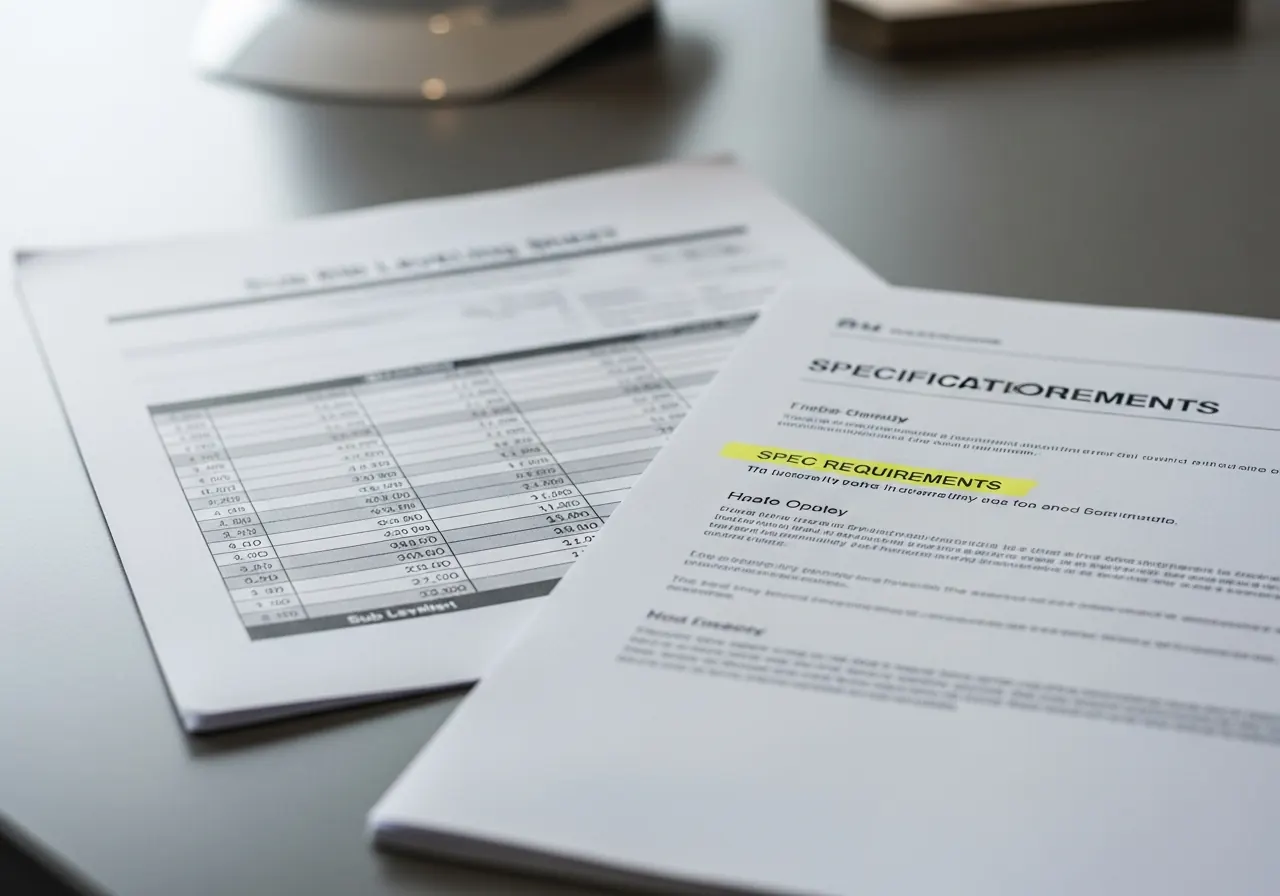
On a 20-trade commercial project, the GC is managing spec-driven scope questions across Division 03 concrete, Division 04 masonry, Division 05 structural steel, Division 07 roofing and waterproofing, Division 08 doors and hardware, Division 09 finishes, Division 22 plumbing, Division 23 HVAC, Division 26 electrical, Division 28 fire alarm, and more. Each division has trade responsibilities that interface with adjacent divisions, submittal requirements that need coordination across trades, and material standards that need to be met by the sub's chosen products.
Reading all of that thoroughly enough to catch scope gaps during bid leveling is a significant time investment, one that most GC preconstruction teams don't have capacity for on a compressed bid schedule.
How AI Spec Extraction Supports GC Bid Leveling
The primary application of AI spec review for GCs is bid leveling, the process of comparing sub bids against each other and against the spec to verify completeness and identify gaps before award.
AI-extracted spec output gives GCs a structured checklist of what each division requires. During bid leveling, the GC checks each sub's bid against the relevant extraction output:
Material standards compliance. Does the sub's proposed product meet the ASTM, UL, or FM standard referenced in the spec? AI extraction surfaces these standards by section, making it straightforward to verify that sub bids are based on spec-compliant products.
Approved manufacturer list compliance. Is the sub pricing a product from the approved manufacturer list? AI extraction pulls every approved manufacturer list and substitution restriction in the spec, giving the GC a clear reference for every product category during bid leveling.
Submittal requirement completeness. Has the sub accounted for the submittal requirements in their scope? AI-extracted submittal requirements by division provide a checklist the GC can verify against each sub's proposed submittal list or scope exclusions.
Testing and inspection scope. Has the sub included the testing and special inspection costs required by their spec sections, or are they expecting the GC's testing allowance to cover them? AI extraction flags testing and inspection requirements by division so the GC knows exactly what's required for each sub's scope and can verify inclusion during leveling.
Trade responsibility coverage. Are there scope items in the spec that fall between subs, assigned by the spec to one trade but not included in any sub's bid? AI cross-division trade responsibility extraction flags these items, giving the GC a pre-leveling view of where scope gaps are most likely to exist.
Pre-Bid Scope Packages for Subcontractors
Before bid leveling, AI spec extraction enables GCs to send better bid invitations. Instead of asking subs to review the full spec and determine their own scope, GCs can send targeted scope packages derived from the AI extraction output:
- Extracted spec requirements for the sub's relevant divisions
- Approved manufacturer lists for products in the sub's scope
- Submittal requirements the sub will be responsible for
- Specific exclusions and inclusions based on the spec's trade responsibility language
Subs who receive targeted scope packages bid more completely and more consistently, which makes bid leveling faster and produces more accurate sub comparisons. The GC spends less time resolving scope gaps during leveling because the invitations drove more complete bids.
Post-Award Scope Verification
AI spec extraction is also valuable immediately after award, at the point where the GC is defining sub scopes for subcontract preparation.
Before AI tools, GCs defined subcontract scopes from a combination of the bid, the drawings, and the estimator's notes from spec review. The result was subcontract scope language that sometimes missed spec-required items that hadn't been fully captured during the bid.
With AI extraction output available, GC project managers can verify that every spec-required item in a sub's scope is reflected in the subcontract before it's executed. That verification step, cross-checking the draft subcontract scope against the extraction output for the relevant divisions, catches omissions before they become disputes during construction.
Managing Submittal Coordination Across Trades
One of the most time-consuming parts of GC preconstruction is assembling the master submittal log, collecting submittal requirements from all trades, assigning responsibility, setting submission dates, and tracking through the design team review process.
AI spec extraction dramatically accelerates this process. The extraction output for a full spec book includes every submittal requirement across all divisions, organized by division, section, submittal type, and responsible trade. That organized output becomes the foundation of the master submittal log, populated from the spec rather than assembled from sub-provided lists that may be incomplete.
A master submittal log built from AI-extracted spec requirements is more complete from day one, catches obscure submittal requirements that subs sometimes omit, and provides the GC with a defensible, spec-grounded basis for managing the submittal process through construction.
The GC Competitive Advantage
GCs who use AI spec extraction in their preconstruction workflow gain a competitive advantage that's hard to replicate with manual processes: they understand the spec better, faster, and more completely than competitors who are still reading manually.
That understanding shows up in tighter sub scopes, fewer RFIs and scope disputes during construction, better submittal management, and fewer surprise change orders from missed spec requirements. Over a portfolio of projects, those differences compound into meaningfully better margin performance and stronger client relationships.
Further reading: How Construction Tech Is Closing the Spec Gap Between GCs and Subs and From Upload to Output: How SpecSwift Scans Your Spec Documents.