

Share
Estimating has always been a discipline where productivity tools matter. The estimator who can process more information, more accurately, in less time wins more work and protects more margin. The tools available to construction estimators have expanded significantly in the past five years, from AI-powered spec scanning to integrated takeoff platforms to cloud-based bid management systems. This post covers the five categories of tools that are delivering the most measurable time savings for construction estimators in 2026, with honest assessments of what each one does and doesn't do.
Tool Category 1: AI Spec Scanning Platforms
What they do: AI spec scanning tools process construction spec book PDFs and product manual PDFs, extracting material standards, submittal requirements, approved manufacturer lists, trade responsibilities, and testing obligations, organized by CSI division and section number, in minutes rather than hours.
Time savings: 6 to 12 hours per bid, depending on project size and spec complexity. For teams bidding 8 to 12 jobs per month, monthly time savings run 50 to 120 hours, equivalent to adding one to two weeks of estimating capacity per month without adding headcount.
Best use case: Any commercial construction bid prep involving a CSI-formatted spec book. Highest value on complex projects with large spec volumes and on teams bidding at high volume.
What to look for: Construction-specific training (not general-purpose AI), PDF processing capability including OCR for scanned documents, CSI division organization in the output, and extraction of the specific categories that matter for bid prep, not just general document summaries.
Leading option: SpecSwift, purpose-built for construction spec extraction, organized around CSI MasterFormat, designed for estimating team workflows.
Limitation: AI extraction should be reviewed rather than trusted blindly. The estimator's judgment is still required to evaluate what the extraction found and apply it to the bid. AI handles the extraction; the estimator handles the evaluation.
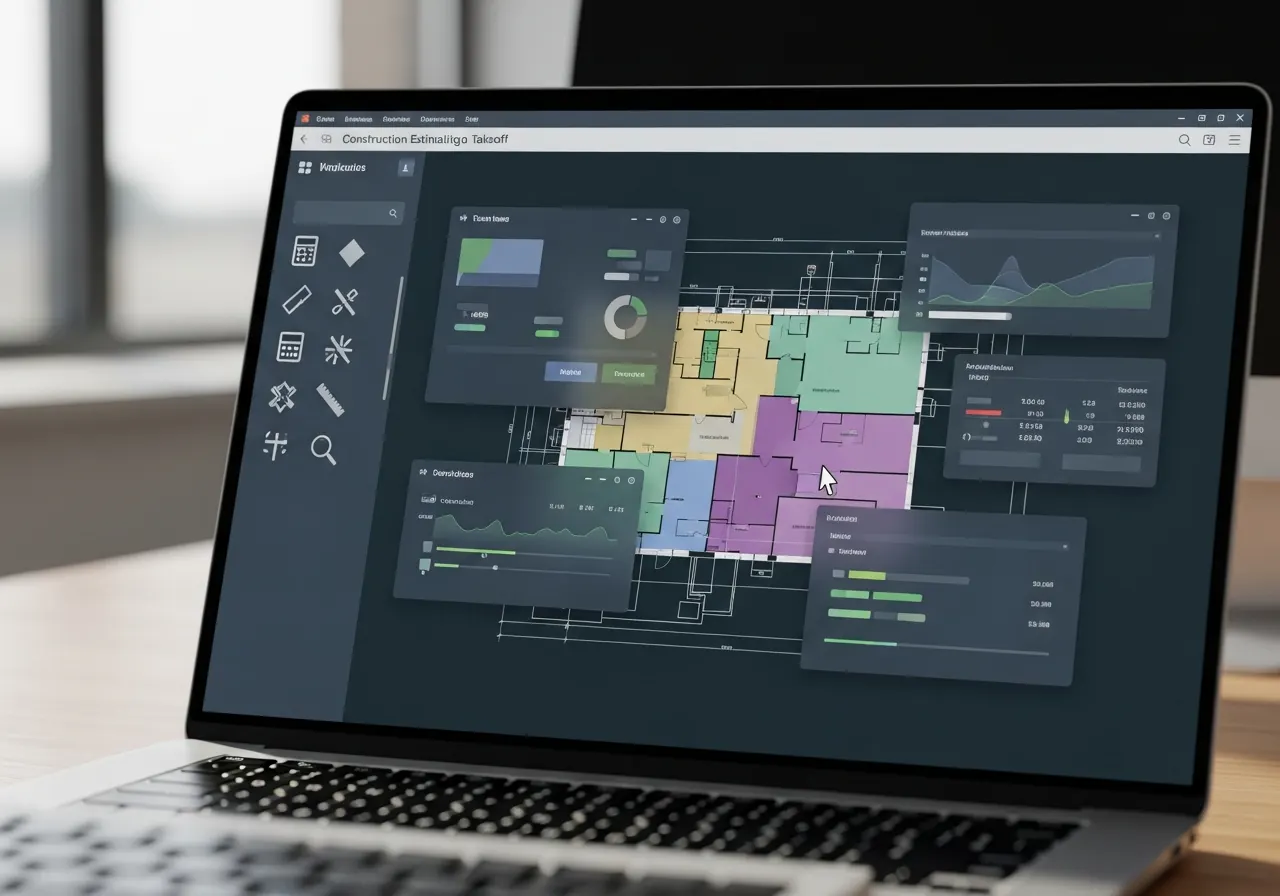
Tool Category 2: Digital Takeoff Software
What they do: Digital takeoff platforms replace manual scaling from paper drawings with point-and-click quantity measurement on digital drawing files. Modern takeoff software supports PDF drawings, CAD files, and BIM models, with automatic scaling, measurement tracking, and integration with estimating software databases.
Time savings: 30 to 60 percent reduction in takeoff time compared to manual methods, depending on the complexity of the scope and the estimator's proficiency with the tool. On a complex mechanical or electrical takeoff, the difference between manual and digital can be a full day of work.
Best use case: Any scope involving quantity measurement from drawings. Most valuable for MEP scopes with extensive linear quantity takeoff (pipe, conduit, ductwork) and for finishes scopes with large area and room count requirements.
What to look for: Support for your primary drawing format (PDF, CAD, BIM), integration with your estimating software, cloud storage for drawing sets, and collaboration features that allow multiple estimators to work on the same drawing set simultaneously.
Leading options: Bluebeam Revu, PlanSwift, Countfire, Trimble Estimation, and Procore Estimating. Each has strengths in different trade types and project sizes.
Limitation: Takeoff software measures quantities. It doesn't interpret specs. The estimator still needs to know what to count and what specifications the counted items need to meet. That spec knowledge comes from spec review, not from takeoff software.
Tool Category 3: Cloud-Based Estimating Software
What they do: Cloud-based estimating platforms provide database-driven cost modeling (assemblies, unit prices, labor rates, material costs) in a collaborative environment that multiple team members can access simultaneously and that maintains a consistent cost database across all bids.
Time savings: Variable by firm, but most estimating teams report 20 to 40 percent reduction in bid assembly time after adopting a well-configured estimating platform. The time savings come from assembly automation (pre-built assemblies that apply multiple cost items at once), database-driven pricing (current costs applied automatically rather than re-researched each bid), and collaboration (multiple team members contributing to the same estimate simultaneously).
Best use case: Teams bidding at volume who benefit from consistent, database-driven cost modeling. Most valuable when the team has invested in building and maintaining a quality cost database that reflects current market conditions.
What to look for: A cost database relevant to your trade and geography, assembly functionality that matches your estimating approach, integration with takeoff software and bid management platforms, and cloud collaboration features.
Leading options: Sage Estimating, ProEst, STACK, Buildertrend (for residential), and trade-specific platforms like Accubid (electrical), QuoteSoft (HVAC), and Trimble MEP.
Limitation: Estimating software is only as good as the cost database behind it. A platform with an outdated or poorly maintained database produces fast but inaccurate estimates. Database maintenance is an ongoing investment that many firms underestimate.
Tool Category 4: Bid Management Platforms
What they do: Bid management platforms streamline the process of sending subcontractor bid invitations, tracking responses, and managing the bid leveling process. They provide a centralized platform for distributing bid documents to subs, tracking who has accessed the documents, receiving and organizing sub bids, and managing bid day leveling.
Time savings: 2 to 4 hours per bid on subcontractor coordination and bid management tasks, following up with subs, tracking responses, organizing bids for leveling. On large projects with 30 to 50 sub invitations, the time savings are more significant.
Best use case: GCs and prime contractors managing large sub bid packages with multiple trade invitations. Particularly valuable for teams bidding multiple jobs simultaneously who need a system to track the status of all open bids.
What to look for: Sub database management, document distribution with access tracking, bid response collection, and bid leveling tools that support apples-to-apples comparison across sub bids.
Leading options: BuildingConnected (part of Autodesk Construction Cloud), SmartBid, iSqFt, and Procore Bid Management.
Limitation: Bid management platforms organize the bid process. They don't improve the quality of the bids themselves. A well-organized bid process with incomplete sub scopes still produces scope gaps. Bid management tools work best when combined with thorough spec review and well-defined scope packages for each sub invitation.
Tool Category 5: AI-Powered Document Analysis for Contract Review
What they do: Beyond spec books, AI document analysis tools are being applied to contract documents, reviewing general conditions, supplementary conditions, and subcontract agreements for unusual risk provisions, unfavorable payment terms, aggressive schedule requirements, and onerous warranty or indemnification clauses.
Time savings: Contract review that previously required an attorney or senior manager spending 2 to 4 hours on a contract document can be compressed to a 30-minute AI-assisted review that flags the high-risk provisions for human evaluation. The attorney or manager then spends their time on the flagged items rather than reading everything.
Best use case: GCs and subs reviewing project contracts before execution, particularly for new owners, new markets, or contract forms that deviate significantly from standard AIA or ConsensPro forms.
What to look for: Construction-specific contract training (not general legal AI), risk identification organized by contract clause type, and output that flags specific language rather than providing general summaries.
Limitation: AI contract review identifies risk language. It doesn't provide legal advice. The output should be reviewed by someone with contract expertise (legal counsel or experienced contract manager) before decisions are made based on it. AI contract review is a triage tool, not a replacement for legal review on high-stakes contracts.
Building a Tool Stack That Works Together
The highest-performing estimating teams in 2026 aren't using any one of these tools in isolation. They're building tool stacks where each tool handles what it does best:
AI spec scanning handles spec book and product manual extraction at the start of the bid cycle, providing complete spec knowledge before takeoff begins.
Digital takeoff software handles quantity measurement against drawings, producing accurate quantities faster than manual methods.
Cloud estimating software applies those quantities to a current, trade-specific cost database, producing accurate pricing faster than manual cost lookup.
Bid management platforms handle sub outreach and bid day coordination, organizing the process so nothing falls through the cracks.
AI contract review handles preliminary contract risk identification before execution, focusing legal review resources on the provisions that warrant attention.
Each tool addresses a specific bottleneck in the estimating workflow. Together, they produce a bid prep process that's faster, more complete, and more accurate than any single tool, or any fully manual process, can achieve alone.
Further reading: Best AI Tools for Construction Spec Review in 2026 and How to Cut Bid Prep Time in Half Using AI on Your Spec Documents.