


Share
Every estimator has a process for spec review. The problem is that most of those processes developed informally (built from habit, past experience, and the particular way each person was trained. They work most of the time. But "most of the time" means requirements get missed on some bids, and those missed requirements show up as problems during construction. A structured checklist approach to spec review closes the gaps that informal processes leave open. This post gives you a practical, repeatable checklist for spec book review before bidding) and shows how AI extraction accelerates every step on it.
Why Checklists Work for Spec Review
Checklists work in construction spec review for the same reason they work in aviation and surgery: complex, multi-step processes performed under time pressure by skilled professionals produce better outcomes when steps are explicitly verified rather than assumed.
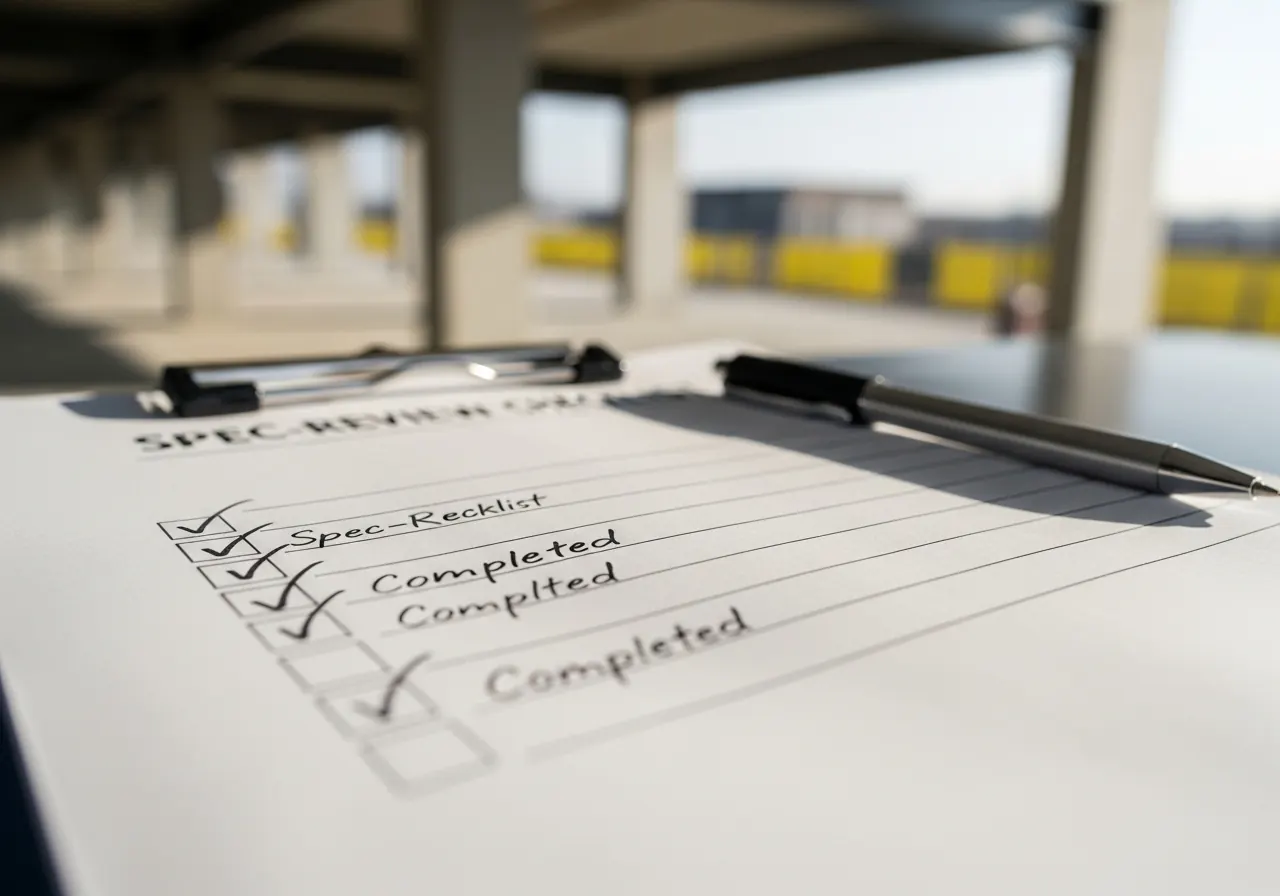
An experienced estimator reviewing a spec book isn't the problem. The problem is that spec review is a multi-category extraction task (you're simultaneously looking for material standards, submittal requirements, trade responsibilities, testing obligations, and compliance language) and performing it under deadline pressure on a document that wasn't designed for easy extraction. In that environment, items get missed not because the estimator isn't skilled but because the task is genuinely difficult to do completely without a structured approach.
A checklist doesn't slow the process down. It makes sure nothing gets left out.
The Pre-Review Setup Checklist
Before you open the spec book, verify these items:
☐ Confirm you have the current spec book version. Check for addenda issued during the bid period. Addenda modify spec sections, working from the original spec when addenda have been issued means you're pricing requirements that may have changed. Get the addenda and either use a spec that incorporates them or review them alongside the original.
☐ Identify the relevant CSI divisions for your scope. Know which divisions you need to review before you start. For a mechanical sub: Division 01, 22, 23, and adjacent sections of 26 and 28. For a roofing contractor: Division 01, 07, and the sheet metal sections. For a GC: all divisions. Define your scope before you start reading.
☐ Upload the spec book to your AI extraction tool. If you're using SpecSwift, upload the spec book now, before you start manual review. Processing happens in the background while you do other work, and the extraction output is ready when you need it.
☐ Note the bid deadline and work backward. How many days do you have for spec review before takeoff needs to start? How many days before bid assembly? Set your spec review time budget before you start.
The Division 01 Checklist
Division 01, General Requirements, applies to every contractor on the project. Read it before any other division.
☐ Submittal procedures. How many copies are required? Electronic or paper? What's the design team's review period? Is a submittal schedule required, and when is it due?
☐ Quality control requirements. Are there project-specific quality control plans required? Mock-up requirements that apply project-wide? Third-party quality oversight?
☐ Special inspection program. Is the special inspection program defined in Division 01? If so, which scopes require special inspection, at what frequency, and who coordinates the testing agency?
☐ Temporary facilities requirements. Are there project-specific requirements for temporary power, temporary enclosures, or site logistics that affect your scope?
☐ Closeout requirements. What documentation is required at project closeout? As-built drawings, O&M manuals, warranties, training records? Understand these at bid time, not at closeout.
☐ Phasing and sequencing requirements. Does the project have construction phases that affect your installation sequence or access? Are there occupancy requirements that create work restrictions?
The Trade-Specific Division Checklist
For each relevant spec division, work through this checklist section by section:
Part 1, General:
☐ Scope inclusions and exclusions. What does this section explicitly include in scope? What does it explicitly exclude and reference elsewhere?
☐ Related sections. What other spec sections are referenced? Do you need to read those sections to understand your full scope?
☐ Submittal requirements. List every action submittal and informational submittal required. Note the type (shop drawings, product data, samples, certificates), the specific product or system it covers, and any timing requirements.
☐ Quality assurance requirements. Are there installer qualification requirements? Manufacturer qualification requirements? Pre-installation conference requirements? Mock-up requirements?
☐ Regulatory requirements. What codes and standards are referenced? Are there specific editions or local amendments that apply?
☐ Warranty requirements. What warranty duration is required? Are extended warranties required? What conditions must be met for the warranty to be valid?
☐ Closeout requirements. What section-specific closeout documentation is required beyond the Division 01 requirements?
Part 2, Products:
☐ Material standards. List every ASTM, UL, FM, ANSI, NFPA, or other standard reference. Note which product or material each standard governs.
☐ Approved manufacturers. List every approved manufacturer for every specified product. Note any no-substitution restrictions or substitution approval requirements.
☐ Product performance requirements. What performance criteria must specified products meet? Compressive strength, thermal performance, fire rating, acoustic rating?
☐ Required accessories. Are there accessories, components, or companion products required for a complete installation that aren't included in the base product price?
Part 3, Execution:
☐ Substrate and pre-installation requirements. What substrate conditions are required before installation can begin? Who is responsible for verifying those conditions?
☐ Installation sequence requirements. Does the spec require installation in a specific sequence? Are there dependencies on other trades' work?
☐ Trade responsibility language. Who furnishes? Who installs? Who connects? Who coordinates? Are there scope items assigned to your trade in this section that weren't in your initial scope plan?
☐ Field testing requirements. What testing is required after installation? Pressure testing, functional testing, performance verification? Who performs it and who witnesses it?
☐ Tolerance requirements. What flatness, plumb, level, or alignment tolerances are specified? How will compliance be verified?
The Cross-Division Trade Responsibility Checklist
☐ Review adjacent divisions for scope language that affects your trade. A mechanical sub should review Division 26 for HVAC power connection responsibilities. A roofing contractor should review Division 07 sheet metal sections for edge metal scope. An electrical sub should review Division 28 for fire alarm system interface responsibilities.
☐ Identify furnished-by/installed-by splits. Any item that one trade furnishes and another installs needs explicit scope assignment in both bids. Verify that every FBBA item is accounted for.
☐ Check Division 01 for project-wide coordination requirements. Some projects have specific MEP coordination requirements, BIM coordination requirements, or prefabrication requirements defined in Division 01 that affect multiple trades.
The Final Bid Review Checklist
Before the bid goes out:
☐ Every extracted spec requirement is reflected in the bid. Check extracted material standards, testing requirements, mock-up requirements, and special inspection obligations against the bid line items.
☐ Every submittal requirement is on the submittal list. The submittal list built during spec review should be complete and assigned to responsible parties.
☐ Every approved manufacturer restriction is reflected in product pricing. Products priced from outside the approved list create submittal risk. Verify compliance before bid submission.
☐ Long-lead items are identified and lead times are accounted for. Equipment or materials with significant lead times should be flagged and their impact on the project schedule assessed.
☐ Addenda items are incorporated. Any spec changes issued via addenda during the bid period are reflected in the bid.
Using AI to Work Through This Checklist Faster
The checklist above represents a thorough spec review process. Done manually, working through every item for a complex commercial project takes a full day or more. With AI spec extraction, the extraction portion of each checklist item (identifying material standards, listing submittal requirements, flagging trade responsibility language) is done automatically.
The estimator's role shifts from extraction to verification: reviewing the AI-extracted output against the checklist, confirming that the relevant items have been captured, and applying judgment to what the extraction found. That shift reduces the time to complete the checklist from a full day to a few hours, and produces a more complete result because AI extraction doesn't miss items due to fatigue or deadline pressure.
Further reading: Free Spec Review Checklist for Construction Estimators and 5 Things Every Estimator Should Extract from a Spec Book Before Pricing.