


Share
Bid prep is a process (and like any process, it can be optimized. Most estimating teams have workflows that evolved organically over years of practice rather than being deliberately designed for speed and completeness. The introduction of AI spec scanning creates an opportunity to rethink that workflow from the ground up) not by adding a new tool to an existing process, but by restructuring the process around what AI does well and what experienced estimators do well. This post lays out what that restructured workflow looks like in practice.
Why Most Bid Prep Workflows Have the Same Bottleneck
Before redesigning the workflow, it's worth understanding why current bid prep workflows are slow. The bottleneck in almost every estimating team's bid prep process is the same: the gap between receiving the bid documents and having enough information about the spec to start estimating.
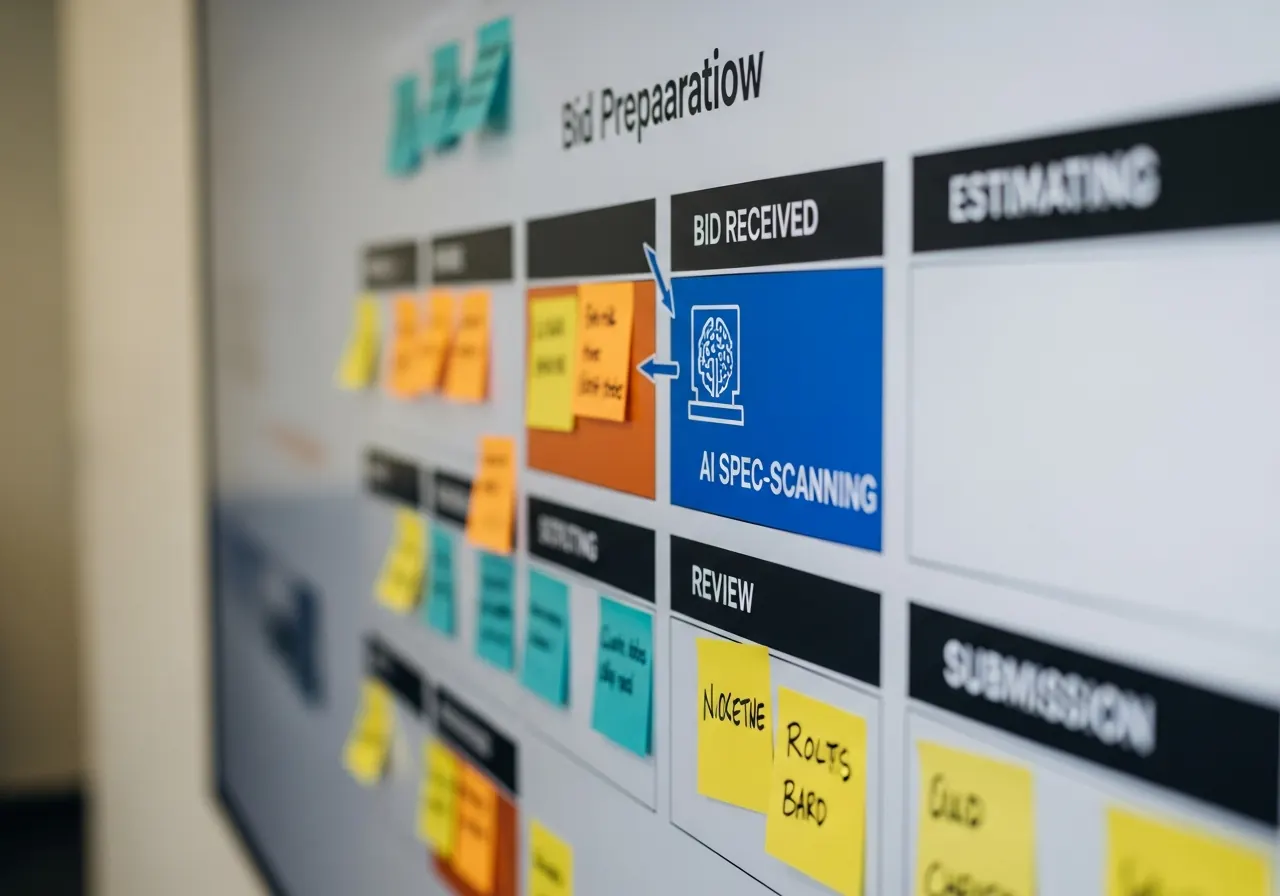
That gap is filled by spec review, and in a manual workflow, spec review is a sequential, time-intensive process that can't easily be parallelized or delegated. One person reads the spec, takes notes, and eventually produces the information that the rest of the team needs to estimate. Until that information exists, estimating waits.
AI spec scanning eliminates that bottleneck by compressing the spec review phase from hours to minutes. But to capture the full benefit, the rest of the workflow needs to reorganize around that compressed timeline.
The Redesigned Bid Prep Workflow
Day 1, Bid documents received:
Upload the spec book PDF to SpecSwift immediately upon receipt. Don't wait until you've reviewed the drawings. Don't wait until you've assessed whether the project is worth bidding. Upload first, because the extraction runs in the background and the output is ready before you need it.
While SpecSwift processes the spec book, which takes minutes, do your initial project assessment: review the drawing index, assess project size and complexity, check the bid deadline and your team's capacity, and make the go/no-go decision.
By the time your go/no-go decision is made, your spec extraction is ready.
Day 1, Review extraction output:
Review the SpecSwift output with your initial project assessment in mind. You're looking for three things at this stage:
First, scope confirmation, does the extracted scope match what you expected based on the drawings and project description? Are there spec sections that indicate scope you didn't anticipate?
Second, red flags, are there requirements in the extracted output that create unusual risk or cost? Tight approved manufacturer lists with no substitutions. Extensive commissioning requirements. Special testing programs. Extended warranty obligations. These items need to be understood early because they affect how you approach the bid.
Third, long-lead items, what submitted products or equipment have lead times that could affect the project schedule? Flagging these on day one allows you to start lead time conversations with suppliers immediately, before the bid is even submitted.
Day 1-2, Scope development:
With extraction output in hand, develop your scope matrix (a structured list of all work items in your scope, organized by CSI division, with the key spec requirements for each item noted. This document becomes the backbone of your bid) the thing everything else gets built against.
The scope matrix built from AI-extracted spec requirements is more complete and faster to produce than one built from manual spec notes. The estimator is organizing and evaluating information, not hunting for it.
Day 2-3, Takeoff and pricing:
With a complete scope matrix in hand, takeoff and pricing can proceed with confidence. Estimators know what they're counting and what standards the counted items need to meet. Quantity surveyors know which material specifications apply to which building elements.
The extracted material standards from SpecSwift tell the estimator which products to price and which approved manufacturers to solicit quotes from. The extracted submittal requirements tell the estimator which products need submittal preparation time factored into the schedule.
Day 3-4, Subcontractor and supplier outreach:
Send bid invitations to subcontractors and suppliers with specific scope notes derived from the extracted spec requirements. Instead of sending a generic "please provide a price for your scope" invitation, send invitations that specify the approved manufacturer list, the relevant ASTM standards, and the submittal requirements for the scope you're soliciting.
Subcontractors who receive specific, spec-driven scope invitations produce better bids. They know what's expected, they include the right products, and they're less likely to miss requirements that create scope gaps.
Day 4-5, Bid assembly and review:
Assemble the bid with the scope matrix as the organizational framework. Each line item in the bid traces back to a spec requirement. Pricing is based on spec-compliant products from approved manufacturers. Testing costs, commissioning costs, and special inspection fees are included because they were extracted from the spec during day one.
Before submission, review the bid against the extraction output as a final check. Is every extracted requirement reflected somewhere in the bid? Are there any flagged items from the initial review that haven't been resolved?
What This Workflow Recovers
The redesigned workflow recovers time in three places:
Spec review time: from 6 to 10 hours to 30 to 40 minutes. This is the most visible recovery.
Scope development time: from scratch-built to extraction-organized. The scope matrix is faster to build when the spec information is already organized.
Bid review time: from memory-based to extraction-verified. Checking a bid against organized extraction output is faster and more reliable than checking it against memory of a manual spec read.
Total time recovery on a typical commercial bid: 8 to 12 hours. For a team bidding ten jobs per month, that's 80 to 120 hours of capacity recovered monthly, without adding a single person to the team.
Making It Stick
The workflow change that matters most is the first one: upload the spec book on day one, before anything else. That single habit change ensures that extraction output is available when you need it rather than being a catch-up task later in the bid cycle.
Everything else in the redesigned workflow follows from having complete spec information available early. The scope matrix gets built from it. Supplier outreach gets targeted by it. Bid assembly gets organized around it. The earlier and more completely you have spec information, the better every downstream step becomes.
Further reading: How to Cut Bid Prep Time in Half Using AI on Your Spec Documents and Why the Fastest Estimators Are Using AI to Scan Specs Before Anyone Else and SpecSwift vs. Reading the Spec Yourself: What Changes.
That's posts 31 to 35. Ready for 36 to 40 whenever you say go.